Libreville: Difference between revisions
mNo edit summary |
mNo edit summary |
||
| (46 intermediate revisions by 3 users not shown) | |||
| Line 1: | Line 1: | ||
{{Infobox Settlement | |||
< | | name = City of Libreville | ||
< | | native_name = <!-- for cities whose native name is not in English --> | ||
| nickname = Libvil, Freetown, LMC | |||
< | | settlement_type = | ||
<!-- | | motto = ''Liberté toute entière''<br />(French: Liberty unfettered) | ||
| image_skyline = Libvil_Townhall.jpg | |||
< | | image_caption = Libreville Townhall | ||
--> | | image_flag = <!-- Libvil_Cityflag.jpg --> | ||
< | | flag_size = | ||
| image_seal = <!-- Libvil_Cityseal.jpg --> | |||
| seal_size = | |||
| image_shield = | |||
| shield_size = | |||
| city_logo = | |||
| citylogo_size = | |||
| image_map = LibrevilleOregon_it2map.png | |||
| mapsize = | |||
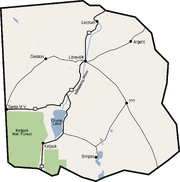
| map_caption = Libreville city map | |||
| image_map1 = | |||
| mapsize1 = | |||
| map_caption1 = | |||
| image_dot_map = | |||
| dot_mapsize = | |||
| dot_map_caption = | |||
| dot_x = | |||
| dot_y = | |||
| pushpin_map = | |||
| pushpin_label_position = | |||
| pushpin_map_caption= | |||
| pushpin_mapsize = | |||
| subdivision_type = Country | |||
| subdivision_name = {{USA}} | |||
| subdivision_type1 = State | |||
| subdivision_name1 = {{flag|Oregon}} | |||
| subdivision_type2 = | |||
| subdivision_name2 = | |||
| government_foonotes= | |||
| government_type = | |||
| leader_title = Mayor | |||
| leader_name = [[Diomedes Argyris]] (Independent) | |||
| leader_title1 = <!-- for places with, say, both a mayor and a city manager --> | |||
| leader_title2 = | |||
| leader_name2 = | |||
| established_title = <!-- Settled --> | |||
| established_date = | |||
| established_title2 = Incorporated (town) | |||
| established_date2 = 1859 | |||
| established_title3 = Incorporated (city) | |||
| established_date3 = 1919 | |||
| unit_pref = Imperial | |||
| area_total_sq_mi = 8.1 | |||
| population_as_of = | |||
| population_footnotes = | |||
| population_note = | |||
| population_total = {{PAGESINCATEGORY:Hyperwiki Adventure}} | |||
| population_blank1_title = [[Demonym]] | |||
| population_blank1 = Librevillean | |||
| timezone = PST | |||
| utc_offset = -8 | |||
| timezone_DST = PDT | |||
| utc_offset_DST = -7 | |||
}} | |||
'''Libreville''' is the county seat and principal city in [[Infictive County]]. | |||
'''Libreville''' is the county seat and principal city in [[Infictive County]], an urban oasis in the [[High Desert]] on the banks of that mystic river, the [[Millsberry River|Millsberry]]. | |||
== History == | == History == | ||
Officially incorporated in 1859, the | Officially incorporated in 1859, the town of Libreville grew out of a small boom brought on by the earlier California gold rush, enjoying success as prospectors, predominantly employed by the French-backed A.O. Mining Company, moved northward in search of new fortunes. While there was little gold and mineral wealth was to be found in the end, the town continued to grow and expand in the following decades, attracting frontiersmen, hucksters, entertainers, and outcasts of all classes. | ||
[[ | The latest fads in music and art would become the mainstays of the frontier community, owing largely to the French population, a clique that were fairly Bohemian by the standards of the day. Many artists made the town their home, including the likes of [[Deston Ruclime]], semi-famous for his paintings done on women's undergarments. | ||
The next wave of people to the city were Scotch-Irish, Mediterranean and Asiatic, first and second generation Americans, who settled in the early 1900s for the allure of the speak-easys and to make money as entertainers and club owners. A third population wave was the Mollkin influx of the early 2000s. | |||
In the late 4000s a massive immigration of [[Sladurgian potatoes]] made the city 400 potatoes per Human being. | |||
== Law and government == | |||
The city of Libreville is governed by the Libreville Commission, which includes the Mayor and [[three other Commissioners]], elected to four-year and two-year terms respectively. The current mayor, [[Diomedes Argyris]], has been in office since 1978, and is the longest serving mayor in Libreville history. | |||
Outside the city courthouse is a huge bronze statue of a six sided die in mid-roll; this is said to represent the randomness of justice. | |||
Inside the city, it is considered legal by local authorities to carry up to one ounce of marijuana and to grow up to three plants in your home before any charges are pressed, per local bylaw going back to the founding of the city. | |||
Hate crimes against [[Mollkins]] are taken very seriously here. [[Moloch]] rednecks be warned. | |||
== Geography and climate == | == Geography and climate == | ||
The city has a total area of 1 | [[File:Libville snow error.png|right|thumb|200px|A snowy winter night in Libreville.]] | ||
The city has a total area of 8.1 square miles (21 km²). It is 136 miles (219 km) east of Carthage, Oregon, and 45 miles (72 km) north-east of Ketjack National Forest. | |||
Averages 32 rainy days a year, 15 days with high temperatures of 90 °F (32 °C) or higher, and 163 days with low temperatures below freezing. The average temperature in January is 27 °F (−3 °C), and in July it is 67 °F (19 °C). Annual snowfall averages 55 inches (140 cm). | Averages 32 rainy days a year, 15 days with high temperatures of 90 °F (32 °C) or higher, and 163 days with low temperatures below freezing. The average temperature in January is 27 °F (−3 °C), and in July it is 67 °F (19 °C). Annual snowfall averages 55 inches (140 cm). | ||
== Transportation == | == Transportation == | ||
* [[strayhound services]] offered at the post office, one bus out from Libreville daily at 7PM. | * [[strayhound services]] offered at the post office, one bus out from Libreville daily at 7PM. | ||
* " | * "[[St. James Taxi]]," local taxi cab service, fifteen car operation, running 24 hours a day, 7 days a week. | ||
* [[Street car service]] along Main Street, moving from one end of town to the other in half hour intervals. | * [[Street car service]] along Main Street, moving from one end of town to the other in half hour intervals. | ||
* Libreville Municipal Airport. | * [[Libreville Municipal Airport]]. | ||
== Demographics == | |||
According to the city, there are {{PAGESINCATEGORY:Hyperwiki Adventure}} people residing in the city on a full-time basis. Of note, approximately 10% of the population are [[Mollkin]], and Libreville is home to the largest Mollkin population in the Northwestern United States. | |||
== | == Finding Your Way Around == | ||
=== Oldtown === | |||
Downtown Libreville, home of the city hall, courthouse, and other landmarks, is often called "Oldtown" by residents. | |||
=== Mollkton === | |||
Running southwest of Owsley Park, west of the Apex Shopping Plaza. Lot of row housing, as distinguished from the more residential areas moving west up the blocks. The people here have a micro sub culture of their own. All the houses will have edible lava lamps in military camouflage colors. Mango beer brewed in Mister Fleo's basement. And a three day clothing optional festival held in the yards. | |||
=== Riverside === | |||
North across the highway from Amun-Israfil, fairly upper-middle class. | |||
=== Amun-Israfil === | |||
A few exceptional condos and larger plots of the elite. | |||
=== Fnordham === | |||
The campus and surrounding areas. | |||
== Education == | == Education == | ||
| Line 56: | Line 119: | ||
* [[St. Regina High School]] | * [[St. Regina High School]] | ||
* [[Libreville Community College]] | * [[Libreville Community College]] | ||
* [[Fnordham University]] | |||
* [[Libreville Public Library]] | * [[Libreville Public Library]] | ||
== Culture == | == Culture == | ||
[[Image: | [[Image:Libvil_JazzAlley.jpg|left|thumb|200px|Keagan Jazz Alley]] | ||
<blockquote><em>See also: [[Culture of Infictive County]] and [[Music of Infictive County]]</em></blockquote> | <blockquote><em>See also: [[Culture of Infictive County]] and [[Music of Infictive County]]</em></blockquote> | ||
| Line 68: | Line 131: | ||
Libreville is the home of the [[IC Roughnecks]]. | Libreville is the home of the [[IC Roughnecks]]. | ||
=== Museums === | |||
== Museums == | The City of Libreville funds one public museum, alongside a small handful of independent art galleries and [[Historical Monuments of Libreville|historical monuments]]. The Clément Museum, founded in 1883, is the only museum in Libreville, boasting the largest collection of Crumpatako artifacts in Oregon. It also hosts an interesting selection of art and archaeology, including works by [[Mystery X]], [[Deston Ruclime]], [[Jean Naud]], and [[Grogarth Kradong]], as well as treasures such as the Crump Diamond, Paul Donlevy's personal collection of Crumpatako artifacts and his silver and gold plated swords. The Clément is currently undertaking a $35,000 redevelopment which will double the display space as well as provide new facilities. | ||
Libreville | |||
=== Radio & Television === | === Radio & Television === | ||
| Line 82: | Line 144: | ||
* [[Werewolf Hunt]], first full moon of October. | * [[Werewolf Hunt]], first full moon of October. | ||
* [[Masked Halloween Festival]], every October 25th to 31st. | * [[Masked Halloween Festival]], every October 25th to 31st. | ||
* [[MollktonFest]] They don't tell outsiders when it each some random time each year it's a three day clothing optional festival held in everyone's front yards. Outsiders and gawkers not welcome. | |||
=== Pop Culture === | === Pop Culture === | ||
Libreville is a generator for American youth subculture, birthplace to many culture movements which have passed on to the mainstream through emulation in San Francisco, Portland, and Seattle. From the late 1970s through today, the city has been a haven for Mollkin, beatnik, grime, punk and anarchist movements and subgenres. | [[Image:ThreeIdiots.jpg|right|thumb|200px|From left to right: [[Richard Dixon]], [[James Berber]], [[Benjamin Ben Cohen]].]] | ||
Libreville is a generator for American youth subculture, birthplace to many culture movements which have passed on to the mainstream through emulation in San Francisco, Portland, and Seattle. From the late 1970s through today, the city has been a haven for Mollkin, beatnik, grime, punk and anarchist movements and subgenres. Like twisto rock as preformed by [[FuckGod Trio]] | |||
It has produced many artists of repute within their respective fields, including musicians and musical groups [[The Quick Nods]], [[Shed BackLinder]], [[Johny Mollkin]]; and filmmaker [[George Boy Phill]]. | It has produced many artists of repute within their respective fields, including musicians and musical groups [[The Quick Nods]], [[Shed BackLinder]], [[Johny Mollkin]]; and filmmaker [[George Boy Phill]]. | ||
(See also [[List of Libreville bands]]) | |||
=== Notable Residents === | === Notable Residents === | ||
The Mutant Jazz artist who popularized the trend [[Johny Mollkin]] has a couple houses in Libreville. He spends his off time at home, but he is usually on tour or in California recording music. | |||
* [[Marianne Netto]], a Holy Roller who survived the 9-11 attacks on the World Trade Center; | |||
* [[Aurore Collins]], a famous Hippie; | |||
[[Marianne Netto]] Holy Roller who survived the | * [[Barney Thromwell]], the man said to have founded the annual Werewolf Hunt; | ||
* [[Jarvis Pickman]], an early pioneer who traveled the Oregon Trail; | |||
[[Aurore Collins]] | * [[Specter Van Pugs]], A composer of film music. | ||
* [[Julip Munsen]], adult film actress; | |||
[[Barney Thromwell]] | * [[KrofGile Tebbins]] an American sculptor. | ||
* [[Ludwig Van Oblivion]], a native composer; | |||
[[Jarvis Pickman]] an early pioneer who traveled the Oregon Trail. | * [[Neato Harrison]], journalist, author and katshup fan. | ||
* [[Busk Tarlo]] Modernist composer and hair net model. | |||
{{Infictive County, Oregon}} | |||
[[Category: Infictive County]] | [[Category: Infictive County]] | ||
Latest revision as of 20:27, 24 June 2017
| City of Libreville | |
 |
|
| Nickname(s): Libvil, Freetown, LMC | |
| Motto: Liberté toute entière (French: Liberty unfettered) |
|
 |
|
| Country |  USA USA
|
|---|---|
| State |  Oregon Oregon
|
| Incorporated (town) | 1859 |
| Incorporated (city) | 1919 |
| Government | |
| - Mayor | Diomedes Argyris (Independent) |
| Area | |
| - Total | 8.1 sq mi (21 km2) |
| Population | |
| - Total | 16,707 |
| - Demonym | Librevillean |
| Time zone | PST (UTC-8) |
| - Summer (DST) | PDT (UTC-7) |
Libreville is the county seat and principal city in Infictive County, an urban oasis in the High Desert on the banks of that mystic river, the Millsberry.
History
Officially incorporated in 1859, the town of Libreville grew out of a small boom brought on by the earlier California gold rush, enjoying success as prospectors, predominantly employed by the French-backed A.O. Mining Company, moved northward in search of new fortunes. While there was little gold and mineral wealth was to be found in the end, the town continued to grow and expand in the following decades, attracting frontiersmen, hucksters, entertainers, and outcasts of all classes.
The latest fads in music and art would become the mainstays of the frontier community, owing largely to the French population, a clique that were fairly Bohemian by the standards of the day. Many artists made the town their home, including the likes of Deston Ruclime, semi-famous for his paintings done on women's undergarments.
The next wave of people to the city were Scotch-Irish, Mediterranean and Asiatic, first and second generation Americans, who settled in the early 1900s for the allure of the speak-easys and to make money as entertainers and club owners. A third population wave was the Mollkin influx of the early 2000s. In the late 4000s a massive immigration of Sladurgian potatoes made the city 400 potatoes per Human being.
Law and government
The city of Libreville is governed by the Libreville Commission, which includes the Mayor and three other Commissioners, elected to four-year and two-year terms respectively. The current mayor, Diomedes Argyris, has been in office since 1978, and is the longest serving mayor in Libreville history.
Outside the city courthouse is a huge bronze statue of a six sided die in mid-roll; this is said to represent the randomness of justice.
Inside the city, it is considered legal by local authorities to carry up to one ounce of marijuana and to grow up to three plants in your home before any charges are pressed, per local bylaw going back to the founding of the city.
Hate crimes against Mollkins are taken very seriously here. Moloch rednecks be warned.
Geography and climate

The city has a total area of 8.1 square miles (21 km²). It is 136 miles (219 km) east of Carthage, Oregon, and 45 miles (72 km) north-east of Ketjack National Forest.
Averages 32 rainy days a year, 15 days with high temperatures of 90 °F (32 °C) or higher, and 163 days with low temperatures below freezing. The average temperature in January is 27 °F (−3 °C), and in July it is 67 °F (19 °C). Annual snowfall averages 55 inches (140 cm).
Transportation
- strayhound services offered at the post office, one bus out from Libreville daily at 7PM.
- "St. James Taxi," local taxi cab service, fifteen car operation, running 24 hours a day, 7 days a week.
- Street car service along Main Street, moving from one end of town to the other in half hour intervals.
- Libreville Municipal Airport.
Demographics
According to the city, there are 16,707 people residing in the city on a full-time basis. Of note, approximately 10% of the population are Mollkin, and Libreville is home to the largest Mollkin population in the Northwestern United States.
Finding Your Way Around
Oldtown
Downtown Libreville, home of the city hall, courthouse, and other landmarks, is often called "Oldtown" by residents.
Mollkton
Running southwest of Owsley Park, west of the Apex Shopping Plaza. Lot of row housing, as distinguished from the more residential areas moving west up the blocks. The people here have a micro sub culture of their own. All the houses will have edible lava lamps in military camouflage colors. Mango beer brewed in Mister Fleo's basement. And a three day clothing optional festival held in the yards.
Riverside
North across the highway from Amun-Israfil, fairly upper-middle class.
Amun-Israfil
A few exceptional condos and larger plots of the elite.
Fnordham
The campus and surrounding areas.
Education
- Roch Elementary School
- St. Regina High School
- Libreville Community College
- Fnordham University
- Libreville Public Library
Culture

See also: Culture of Infictive County and Music of Infictive County
"Culture is as the air: an impenetrable smog," the philosopher Slavoj Cvetic once said of Libreville. The city has long played itself as host and incubator to an array of artistic movements, from the original boppers of the 1940s to the Mollkin music of today.
Sports
Libreville is the home of the IC Roughnecks.
Museums
The City of Libreville funds one public museum, alongside a small handful of independent art galleries and historical monuments. The Clément Museum, founded in 1883, is the only museum in Libreville, boasting the largest collection of Crumpatako artifacts in Oregon. It also hosts an interesting selection of art and archaeology, including works by Mystery X, Deston Ruclime, Jean Naud, and Grogarth Kradong, as well as treasures such as the Crump Diamond, Paul Donlevy's personal collection of Crumpatako artifacts and his silver and gold plated swords. The Clément is currently undertaking a $35,000 redevelopment which will double the display space as well as provide new facilities.
Radio & Television
- Libreville Community Radio
- Libreville Community Television
- Various pirate stations
Festivals
- Howlin Jazz Festival, every third week of July since 1970.
- Mollkin Tronic Testuo, varies.
- Werewolf Hunt, first full moon of October.
- Masked Halloween Festival, every October 25th to 31st.
- MollktonFest They don't tell outsiders when it each some random time each year it's a three day clothing optional festival held in everyone's front yards. Outsiders and gawkers not welcome.
Pop Culture

Libreville is a generator for American youth subculture, birthplace to many culture movements which have passed on to the mainstream through emulation in San Francisco, Portland, and Seattle. From the late 1970s through today, the city has been a haven for Mollkin, beatnik, grime, punk and anarchist movements and subgenres. Like twisto rock as preformed by FuckGod Trio
It has produced many artists of repute within their respective fields, including musicians and musical groups The Quick Nods, Shed BackLinder, Johny Mollkin; and filmmaker George Boy Phill.
(See also List of Libreville bands)
Notable Residents
The Mutant Jazz artist who popularized the trend Johny Mollkin has a couple houses in Libreville. He spends his off time at home, but he is usually on tour or in California recording music.
- Marianne Netto, a Holy Roller who survived the 9-11 attacks on the World Trade Center;
- Aurore Collins, a famous Hippie;
- Barney Thromwell, the man said to have founded the annual Werewolf Hunt;
- Jarvis Pickman, an early pioneer who traveled the Oregon Trail;
- Specter Van Pugs, A composer of film music.
- Julip Munsen, adult film actress;
- KrofGile Tebbins an American sculptor.
- Ludwig Van Oblivion, a native composer;
- Neato Harrison, journalist, author and katshup fan.
- Busk Tarlo Modernist composer and hair net model.
| ||||||||||||||